
The Salt Hearts of Hallstatt
- Civilization
- Iron Age Austria
- Occupation
- Salt miner at Hallstatt
- Material
- Rock salt
- Period
- c. 700 BC
Deep under the Salzkammergut, by the light of burning fir-splints, Iron Age miners cut salt in heart-shaped plates and hoisted them out through galleries up to 20 metres high. The salt paid for gold, amber and African ivory in the graves below — and archived the working day so completely that the miners' clothing, tools and even their supper survive. In 1734 the mountain returned a miner it had held for two thousand years.
The job
The Iron Age miners of Hallstatt did not chip salt out flake by flake. They cut deep grooves into the rock-salt face in the shape of two arcs meeting at a point — a heart — then levered the whole plate free in one piece. The Natural History Museum Vienna, which has excavated the mine for over a century, holds two original salt plates of about 12 and 42 kilograms; negative impressions left in the mine walls imply that some extracted blocks exceeded 100 kilograms, though modern experiments have not yet reproduced the removal of a plate that size in one piece. The only light was a burning splint of fir or spruce about a metre long — not a torch — and the workings these splints lit were industrial in scale, running to 170 metres in length and up to 20 metres in height.
The Iron Age mine stood on an older foundation: Bronze Age miners had driven shafts into the same mountain centuries earlier, and in 2003 excavators found their wooden staircase in the Christian von Tuschwerk — more than eight metres of modular stair with treads 1.20 metres wide, built for two-way traffic under carrysacks, its timbers dendrochronologically dated to 1108 BC. Children were probably in the galleries too: children's shoes survive from the mine, and children's skeletons from the cemetery show degeneration suggestive of heavy labour. The museum is careful about what that proves — an inference of simple tasks such as minding the splints, not evidence that children performed every mining job.
Is Hallstatt the oldest salt mine in the world?
Hallstatt's claim to the title is continuity. The modern saltworks, which still operates, presents the mountain as the oldest salt mine in the world, and the archaeology behind the slogan is real: salt has been won from this one Alpine mountain, with interruptions, for about 7,000 years. The first traces of salt working reach back toward 5000 BC, the Bronze Age miners drove deep shafts in the second millennium BC and left their staircase of 1108 BC to prove it, the Iron Age galleries of this episode follow, and mining continues today.
'Oldest' always depends on what is being counted: the oldest saltworks, the oldest brine evaporation, or the oldest underground salt mine. Hallstatt's distinction is the last of these, and above all the unbroken line: the same mountain that holds the Bronze Age staircase and the Iron Age salt hearts still ships salt. That continuity, more than any single date, is the claim's real content.
The wealth in the graves
Salt kept winter meat edible in a world without refrigeration, and the mountain that held it sat high above the Alpine trade paths. The cemetery in the high valley shows what that was worth: about 1,500 graves have been excavated — the museum estimates at least 4,000 burials in all — used through roughly 800 to 400 BC, with an unusually high share of richly furnished graves for a cemetery of the period. The furnishings include gold, amber, glass and ivory — the ivory African, arriving through several intermediaries — buried with a mining community in the high Alps, far from any sea.
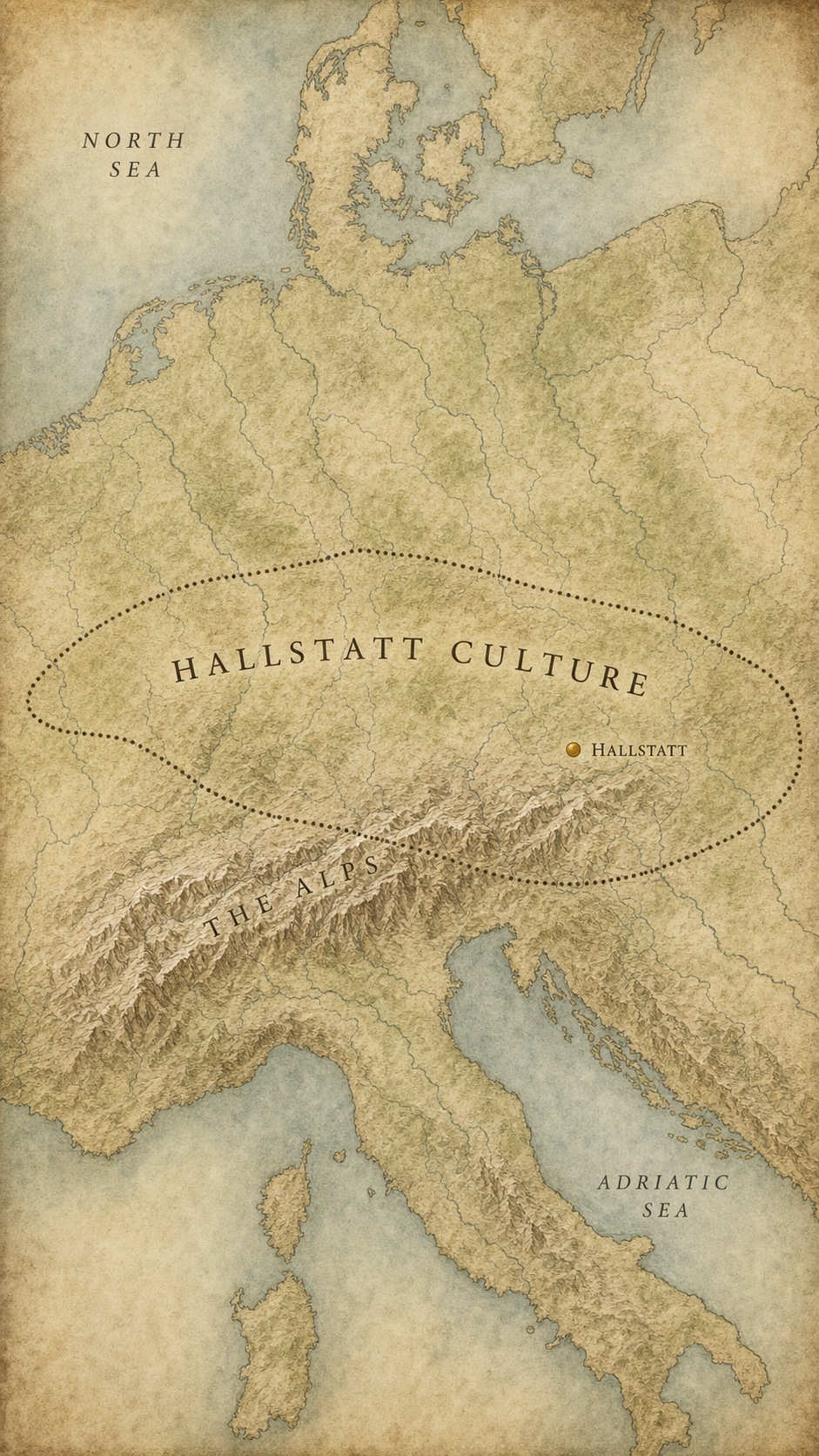
The wealth was distinctive enough that when nineteenth-century archaeologists needed a name for the first phase of the European Iron Age — from eastern France to the Balkans — they named it after this one Austrian lakeside village. The people of the Hallstatt period are conventionally counted among the earliest Celtic-speaking populations; the museum cautions that the older Bronze Age miners of the same mountain should not be called Celts.
What is the Hallstatt period?
In archaeology, Hallstatt is not just a place but a period: the first phase of the European Iron Age, conventionally dated about 800 to 450 BC. When nineteenth-century archaeologists needed a name for the culture whose graves and metalwork they were finding from eastern France to the Balkans, they took it from this village, because the cemetery in the high valley above the lake was the richest type site of the age. The name has stuck for a century and a half: an archaeologist writing about Hallstatt C swords may never have seen the town.
The period label and the mine's own story are joined at the wealth. It was the salt fortune of roughly 800 to 400 BC that filled the graves with gold, amber and African ivory and made the cemetery famous enough to name an age. The people of the Hallstatt period are conventionally counted among the earliest Celtic-speaking populations of Europe, with the museum's standing caution that the older Bronze Age miners of the same mountain should not be called Celts.
The Man in the Salt
In 1734, salt workers cutting in the Kilbwerk broke into prehistoric deposits and found a man embedded in the rock salt — preserved whole, clothing and all, by the mountain that had collapsed on him and sealed the gallery in an instant. Modern research places him in the Early La Tène period, around 350 BC. He is known today only through saltworks and church records: the body was carried down to the valley and buried in Hallstatt's churchyard, so no modern laboratory has ever examined him. His bones may lie among those in the Hallstatt charnel house — but that, the museum notes, is not proven.
The episode's closing line is his epitaph as much as the miner's boast: nothing spoils in the salt. The mountain kept the ropes, the shoes, the supper — and, once, the man.
Sources
- NHM Wien — Mining methods of the Hallstatt period: the salt hearts
- NHM Wien — Everyday working life in the Hallstatt-period mine (splint light, diet)
- NHM Wien — Mining facilities of the Hallstatt period (gallery dimensions)
- NHM Wien — The Man in the Salt (1734 find, churchyard burial)
- NHM Wien — Transport paths: the Bronze Age staircase (dendro-dated 1108 BC)
- NHM Wien — Grave furnishings and trade (gold, amber, African ivory)
- NHM Wien — Anthropology: the cemetery population (children's skeletons, labour)
- NHM Wien — Textiles from the Hallstatt mines (preservation)
- UNESCO World Heritage — Hallstatt-Dachstein / Salzkammergut Cultural Landscape (806)
- Salzwelten Hallstatt — the oldest salt mine in the world (7,000 years of salt)
Tell us in the comments — the next episode is picked from what you ask for.
Subscribe on YouTube Watch the seriesMore from the series

The Men Who Scraped an Empire's Water Clean

The Fire-Gilders of Kaupang